



Table of Contents
Manufacturing lead time issues are one of the most critical factors affecting bulk order delivery in B2B sourcing. Many buyers assume delays happen during shipping, but in reality, most problems originate during the production phase. When lead time is not properly managed, even well-planned orders can fail to meet deadlines. This makes lead time control a key element of supply chain reliability.
In practice, manufacturing lead time issues are often underestimated during supplier selection. Buyers tend to accept quoted timelines without verifying how those timelines are calculated. This creates a mismatch between expectations and actual production capability. As a result, delays become a recurring issue rather than a one-time problem.
What Are Manufacturing Lead Time Issues in Bulk Production
Manufacturing lead time issues refer to delays or inconsistencies in the time required to complete production. This includes everything from raw material preparation to final packaging before shipment. When any stage is not properly managed, the entire timeline is affected. In bulk orders, these delays are amplified due to the scale of production.
Lead time is not a fixed number but a dynamic process influenced by multiple factors. Without structured planning, suppliers cannot accurately predict production duration. This leads to unreliable delivery commitments and frequent schedule changes. For buyers, this creates uncertainty in inventory and sales planning.
Common Causes of Manufacturing Lead Time Issues
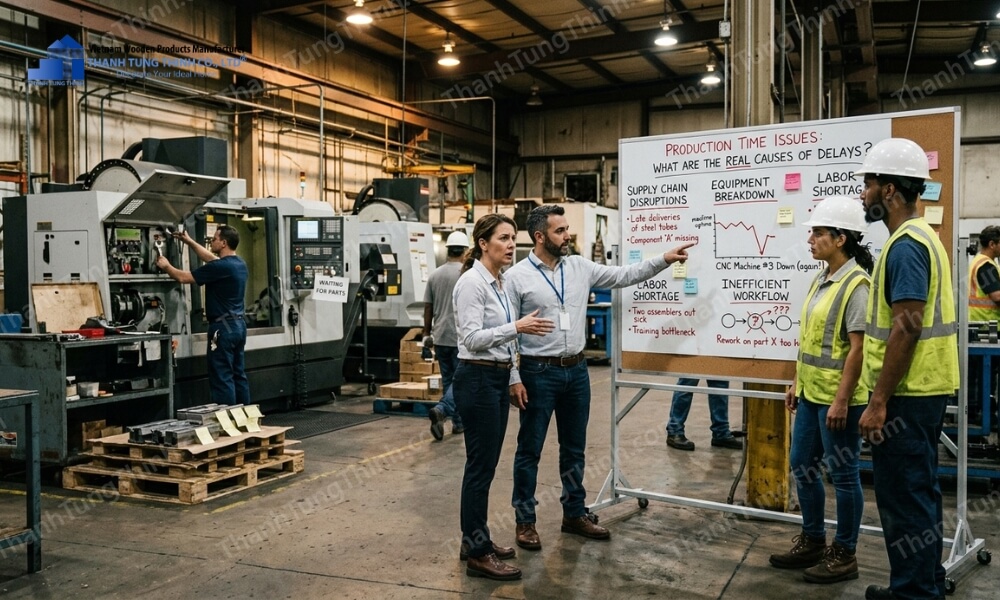
Manufacturing lead time issues are typically caused by internal inefficiencies rather than external disruptions. These problems often stem from weak production systems and lack of operational control. Identifying these causes helps buyers assess supplier reliability more effectively.
- Poor production scheduling and workflow planning
- Delays in raw material sourcing or preparation
- Limited workforce or machine capacity
- Inefficient quality control processes
- Lack of coordination between production stages
These factors create bottlenecks that slow down the entire production process. Once delays begin, they are difficult to recover without structured systems.
Where Manufacturing Lead Time Issues Usually Occur
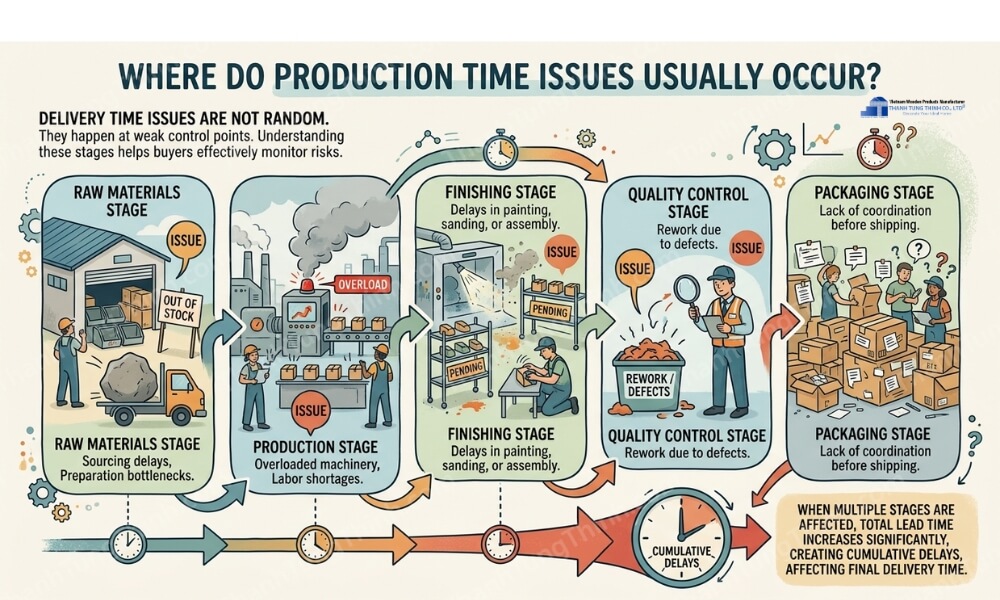
Lead time issues do not happen randomly. They tend to occur at specific stages of the production process where control is weakest. Understanding these points helps buyers monitor risk more effectively.
- Raw material stage: delays in sourcing or preparation
- Production stage: machine overload or labor shortages
- Finishing stage: sanding, coating, or assembly delays
- Quality control stage: rework due to defects
- Packaging stage: lack of coordination before shipment
When multiple stages are affected, total lead time increases significantly. This creates a cumulative delay that impacts final delivery.
How Manufacturing Lead Time Issues Affect Bulk Orders
Manufacturing lead time issues directly impact delivery timelines and overall supply chain stability. When production is delayed, shipment schedules are automatically pushed back. This affects inventory availability and disrupts sales cycles. For businesses relying on consistent supply, this creates serious operational challenges.
In addition, inconsistent lead time makes planning difficult. Buyers cannot accurately forecast stock levels or coordinate marketing activities. This leads to either stock shortages or excess inventory. Over time, these inefficiencies reduce profitability and operational efficiency.
Operational Comparison: Controlled vs Uncontrolled Lead Time
| Factor | Controlled Lead Time | Uncontrolled Lead Time |
|---|---|---|
| Planning | Structured timeline | Rough estimation |
| Production flow | Stable and consistent | Frequent interruptions |
| Delay risk | Low | High |
| Communication | Transparent updates | Unclear progress |
| Delivery | Predictable | Unreliable |
This comparison highlights a key point. Manufacturing lead time issues are not random—they are directly linked to how well production is managed.
How to Evaluate Manufacturing Lead Time Issues Before Ordering
Evaluating manufacturing lead time issues requires a deeper look into how suppliers manage production. Buyers should not rely solely on quoted timelines but need to verify operational capability. This ensures that the supplier can deliver consistently at scale.
- Ask how lead time is calculated
- Request a production schedule with milestones
- Check historical delivery performance
- Evaluate communication during production
- Confirm material sourcing timelines
In real sourcing environments, manufacturers like Thanh Tung Thinh Co., Ltd operate with structured production workflows and controlled lead time systems. With more than 15 years of experience across product categories such as wooden kitchenware, wooden boxes, packaging, natural driftwood, and pet products, they are able to manage multiple production stages efficiently. This allows for more stable lead time and consistent delivery performance in bulk orders.
 WhatsApp: +84 96 394 91 78
 Email: [email protected]
 Website: https://thanhtungthinh.com/
 Pinterest: https://www.pinterest.com/THATUWOOD/
Why Direct Manufacturers Reduce Manufacturing Lead Time Issues
Direct manufacturers have better control over production processes, which helps reduce manufacturing lead time issues. They manage raw materials, labor, and machinery within a single system. This allows for better coordination between production stages. As a result, delays are minimized and timelines are more predictable.
In contrast, suppliers that rely on outsourcing often struggle with coordination. Each production stage may be handled by different parties, increasing the risk of delays. Companies like Thanh Tung Thinh Co., Ltd, with in-house production capabilities, can adjust workflows across product lines such as kitchenware and wooden packaging more efficiently. This flexibility is critical for maintaining stable lead times in bulk production.

Strategies to Reduce Manufacturing Lead Time Issues
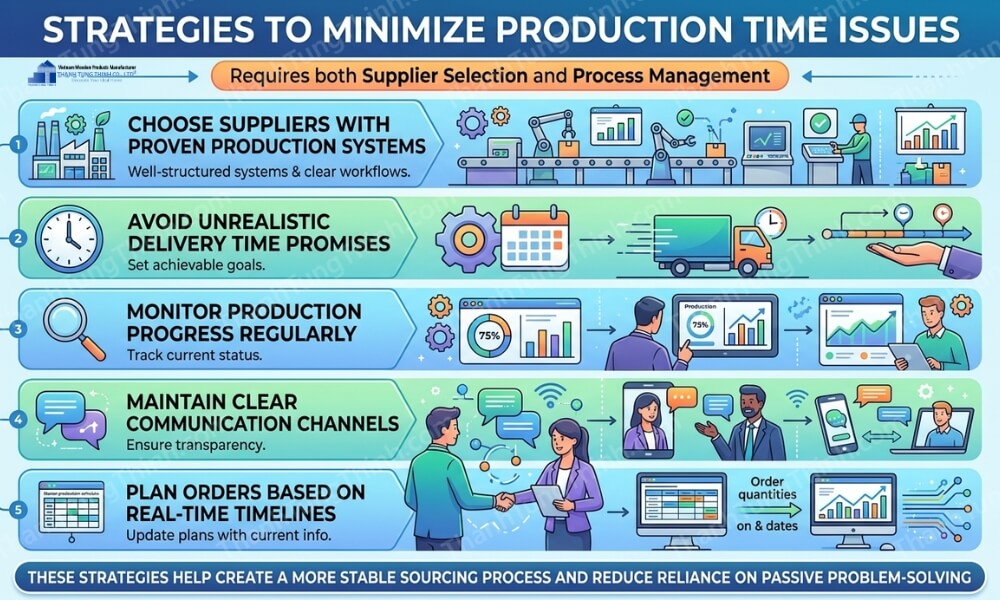
Reducing manufacturing lead time issues requires both supplier selection and process management. Buyers need to work with suppliers that have structured systems and clear workflows. At the same time, internal planning must align with supplier capabilities.
- Choose suppliers with proven production systems
- Avoid unrealistic lead time promises
- Monitor production progress regularly
- Maintain clear communication channels
- Plan orders based on realistic timelines
These strategies help create a more stable sourcing process. They also reduce dependency on reactive problem-solving.
How to Fix Manufacturing Lead Time Issues During Production
Manufacturing lead time issues do not always need to be accepted as fixed problems. In many cases, delays can still be reduced if they are identified early in the production process. The key is to intervene before bottlenecks spread across multiple stages. This requires active monitoring rather than waiting for final delivery updates.
Buyers can take several practical actions to minimize delays during production:
- Request weekly progress updates from the supplier
- Identify bottlenecks in early production stages
- Adjust order priorities if necessary
- Confirm material availability in advance
These actions help maintain control over the production timeline. They also reduce the risk of last-minute delays that are difficult to resolve.
Why Manufacturing Lead Time Issues Are Worse in Bulk Orders
Manufacturing lead time issues become significantly more complex when dealing with bulk orders. Larger production volumes require more coordination between materials, labor, and machinery. Any small delay at one stage can quickly scale into a major disruption. This makes bulk production inherently more sensitive to inefficiencies.
In addition, bulk orders often involve multiple product variations or specifications. This increases production complexity and extends processing time. Without structured systems, suppliers struggle to maintain consistency across all units. As a result, delays in bulk orders are usually longer and harder to recover.
How to Build a Supply Chain That Minimizes Manufacturing Lead Time Issues
Preventing manufacturing lead time issues requires a long-term approach rather than short-term fixes. Buyers need to build relationships with suppliers that prioritize operational stability. This includes working with manufacturers who have structured workflows and proven production systems. Over time, this creates a more reliable sourcing environment.
A stable supply chain is typically built on a few key principles:
- Partner with suppliers that have controlled production capacity
- Maintain consistent order volume instead of sudden spikes
- Align production planning with sales forecasts
- Work directly with manufacturers instead of intermediaries
In practice, manufacturers like Thanh Tung Thinh Co., Ltd are able to support this model through structured production systems and diversified product capabilities across kitchenware, packaging, and driftwood categories. This allows buyers to consolidate sourcing while maintaining stable lead times. For B2B operations, this kind of consistency is often more valuable than short-term cost savings.

Conclusion: Manufacturing Lead Time Issues Define Supply Chain Stability
Manufacturing lead time issues are one of the key factors determining whether bulk orders are delivered on time. When lead time is unstable, delays become unavoidable regardless of other conditions. For buyers, this means that production control is more important than price alone. A stable lead time supports consistent inventory and long-term growth.
If you are managing bulk sourcing or expanding product lines, working with a manufacturer that demonstrates real lead time control is essential. You can consider contacting Thanh Tung Thinh Co., Ltd to review production timelines, request a catalog, or evaluate sample quality. This step helps ensure more predictable delivery and reduces supply chain risk.
Read more:
- Late Delivery in Bulk Orders: Causes, Risks & How to Avoid It
- Supplier Overcapacity Problems: Why Bulk Orders Get Delayed
- Delayed Shipment Impact on Business: Hidden Costs of Late Deliveries
- How to Avoid Late Delivery from Suppliers in Bulk Orders
- How to Choose a Reliable Manufacturer for Bulk Orders

