


Table of Contents
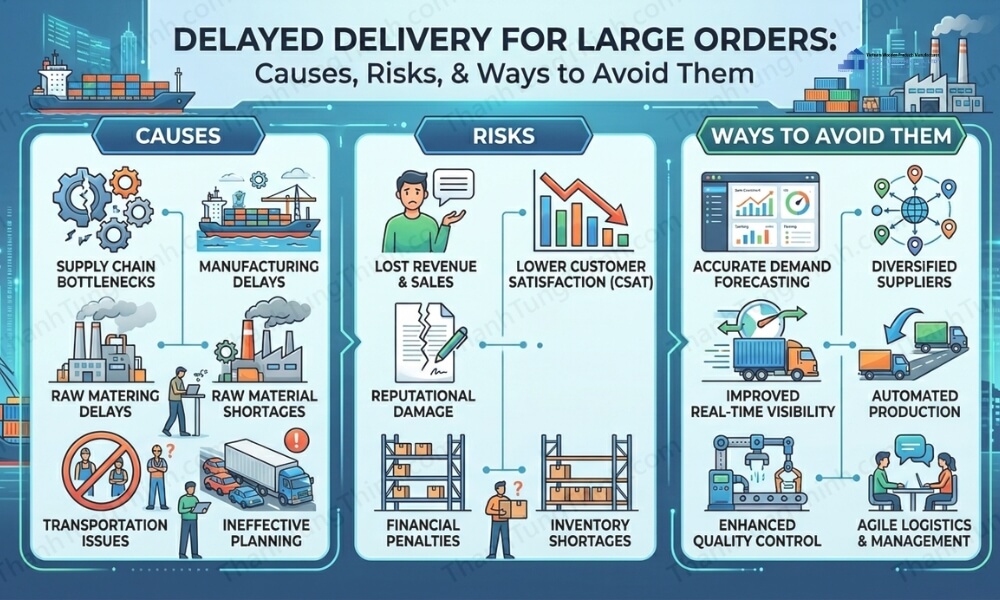
Late delivery in bulk orders is one of the most damaging issues in B2B sourcing because it affects both operations and revenue at the same time. When large-volume orders arrive late, businesses cannot maintain inventory flow or meet customer demand as planned. This creates a chain reaction that impacts sales, marketing, and brand reliability. For companies that rely on consistent supply, even a single delay can disrupt an entire sales cycle.
Most buyers assume delays are occasional or caused by logistics problems, but that assumption is often incorrect. In reality, late delivery in bulk orders is usually the result of internal production failures within the supplier’s system. These failures are predictable and repeatable, especially when suppliers lack proper capacity control and production planning. Understanding this distinction is critical if you want to prevent delays instead of reacting to them.
What Is Late Delivery in Bulk Orders and Why It Keeps Happening
Late delivery in bulk orders refers to situations where suppliers fail to meet agreed production timelines for large-scale manufacturing. Unlike small shipments, bulk delays are rarely caused by shipping issues and are more often linked to production inefficiencies. This means the root problem typically exists before the goods even leave the factory. Without addressing these internal issues, delays will continue to occur regardless of logistics improvements.
The reason this problem keeps happening is simple: many suppliers operate without structured production systems. Timelines are often estimated rather than calculated based on real capacity and workflow constraints. As a result, delivery commitments are made without a reliable operational foundation. This creates a gap between what is promised and what can actually be delivered.
The Real Causes of Late Delivery in Bulk Orders
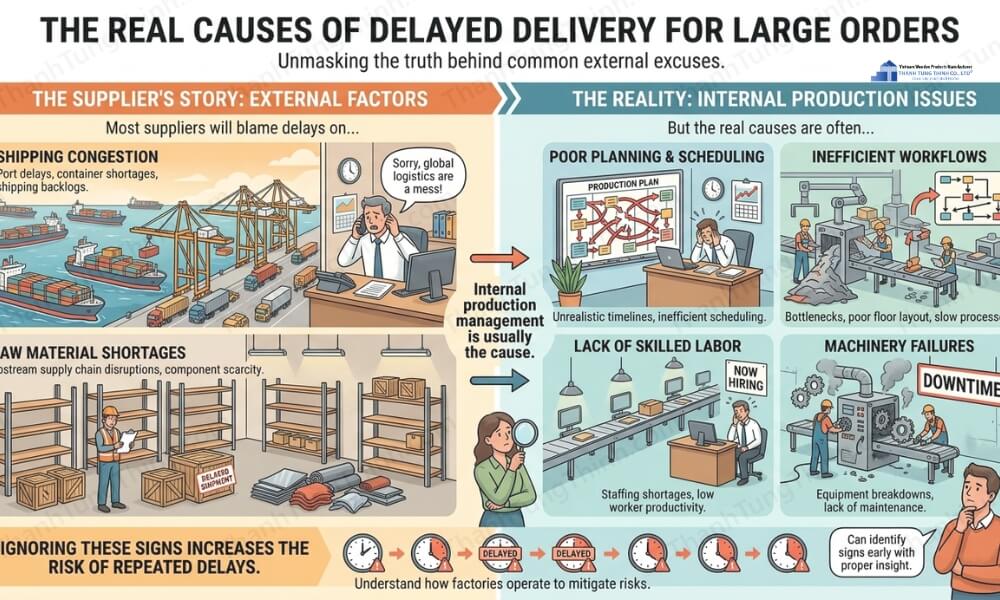
Most suppliers will attribute delays to external factors such as shipping congestion or raw material shortages. However, in most cases, the real causes are internal and directly related to how production is managed. These issues can be identified early if buyers understand how factories operate. Ignoring these signals increases the risk of repeated delays.
Supplier Overcapacity Problems
One of the most common causes of late delivery in bulk orders is supplier overcapacity. Many factories accept more orders than they can realistically handle in order to maximize short-term revenue. This creates an overloaded production environment where resources are stretched beyond their limits. Once capacity is exceeded, delays become unavoidable regardless of initial commitments.
In this situation, suppliers begin to prioritize certain orders over others, often without informing the buyer. Larger or higher-margin clients may receive priority, while smaller orders are pushed back. This lack of transparency creates uncertainty and makes planning difficult for buyers. Overcapacity is not just a risk—it is often the starting point of systemic delay issues.
Production Backlog in Factories
Production backlog occurs when existing orders are not completed on schedule, causing a ripple effect across all incoming orders. Each delayed order pushes the next one further down the production queue, creating a cascading delay. This is particularly common in factories that lack structured scheduling systems. Without clear prioritization, production becomes reactive rather than controlled.
As backlog builds up, recovery becomes increasingly difficult. Even if new orders are smaller or simpler, they are still affected by delays from previous production cycles. This creates a situation where delivery timelines become unpredictable and unreliable. For buyers, this means that once a supplier enters backlog mode, delays are likely to continue.
Manufacturing Lead Time Issues
Lead time mismanagement is another critical factor contributing to late delivery in bulk orders. Many suppliers provide optimistic lead times during negotiation to secure contracts, without aligning them with actual production capacity. This creates unrealistic expectations from the beginning of the project. When production starts, these timelines often prove to be unattainable.
In addition, lead time calculations often fail to account for disruptions such as material shortages, machine downtime, or labor constraints. These variables can significantly extend production timelines if not properly managed. Without a structured approach to lead time planning, delays become inevitable. This mismatch between promise and execution is a key driver of delivery failures.
Lack of Production Transparency
Another major issue is the lack of transparency during the production process. Many suppliers do not provide regular updates or milestone tracking, leaving buyers with limited visibility. This means delays are often discovered only when the expected delivery date is approaching or has already passed. At that point, options for correction are extremely limited.
Without transparency, buyers cannot proactively manage risks or adjust their plans. This creates a reactive environment where decisions are made under pressure. In B2B sourcing, this lack of control can lead to missed opportunities and operational inefficiencies. Transparency is not optional—it is a requirement for reliable supply chain management.
The Business Impact: Why Late Delivery Costs More Than You Think
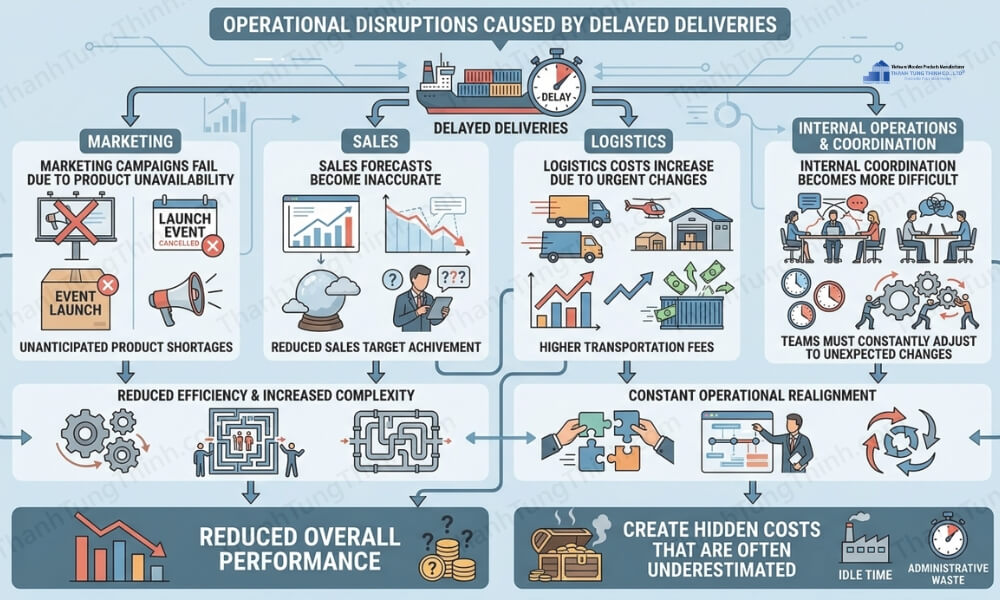
Late delivery in bulk orders has direct financial consequences that go beyond simple delays. When inventory does not arrive on time, businesses cannot fulfill orders or maintain consistent stock levels. This leads to lost sales and missed revenue opportunities, especially during peak demand periods. Over time, these losses accumulate and affect overall profitability.
There are also indirect costs that are often overlooked. Marketing campaigns may fail because products are not available when needed, reducing return on investment. Customer satisfaction declines when orders cannot be fulfilled as promised, leading to negative reviews and reduced loyalty. These long-term effects can be more damaging than the immediate financial loss.
Why Most Buyers Keep Facing the Same Problem
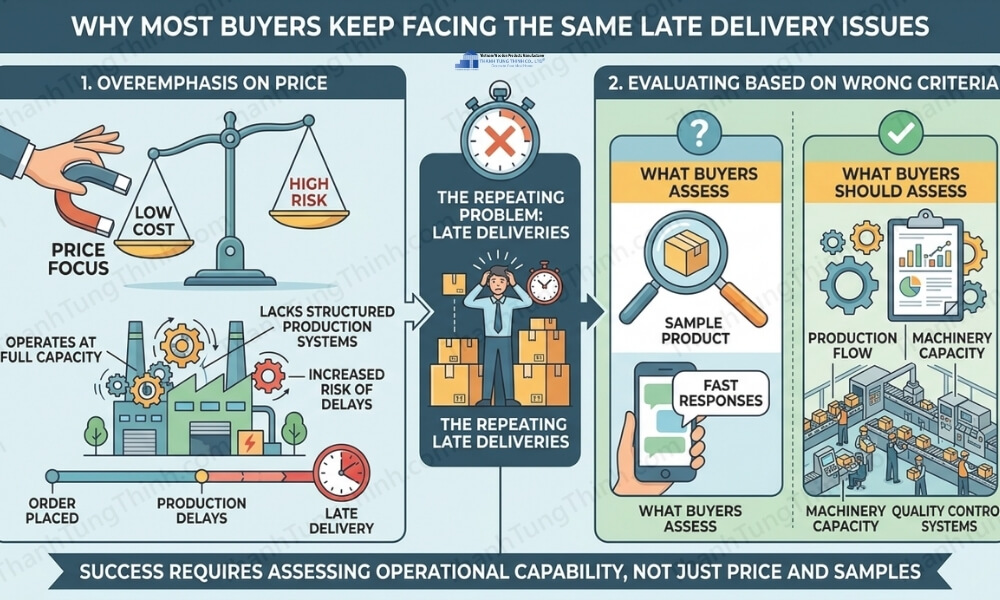
Many buyers repeatedly encounter late delivery issues because they focus too heavily on price when selecting suppliers. While cost efficiency is important, it often comes at the expense of production reliability. Low-cost suppliers are more likely to operate at full capacity and lack structured production systems. This increases the risk of delays and inconsistent performance.
In addition, buyers often evaluate suppliers based on samples and communication rather than operational capability. A good sample does not guarantee consistent bulk production. Fast responses do not reflect actual production efficiency. Without assessing capacity and production systems, buyers are essentially taking a risk with every order.
How to Avoid Late Delivery from Suppliers
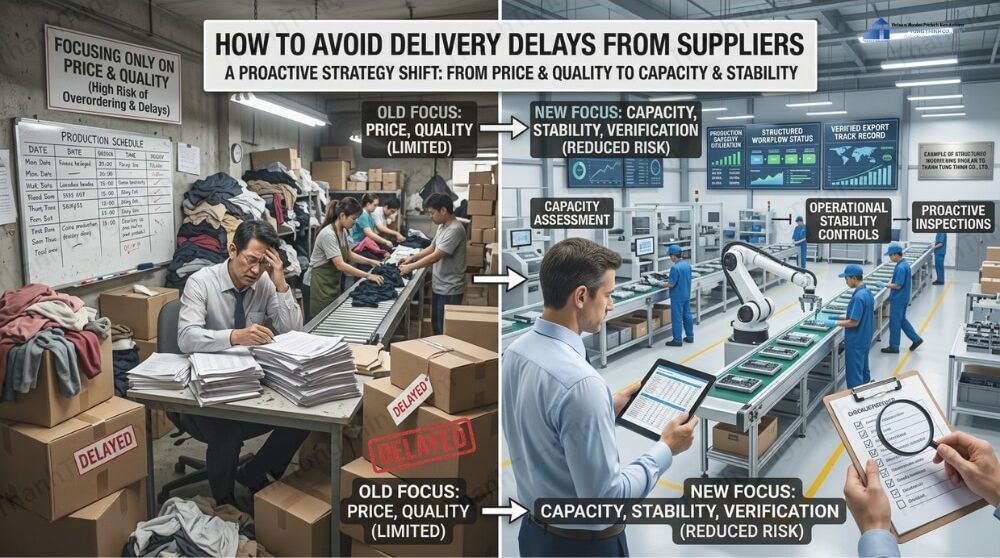
Avoiding late delivery in bulk orders requires a shift in sourcing strategy. Instead of focusing solely on price and product quality, buyers must evaluate production capability and operational stability. This involves asking the right questions and verifying supplier claims with evidence. A proactive approach significantly reduces the risk of delays.
In practice, experienced buyers tend to prioritize suppliers with proven export track records and controlled production systems. For example, manufacturers such as Thanh Tung Thinh Co., Ltd typically operate with defined capacity planning and structured workflows, which reduces the likelihood of overbooking. This kind of operational discipline is often what separates stable suppliers from those that frequently cause delays.
Direct Manufacturer vs Trading Company: Where Delays Really Come From
One of the hidden causes of late delivery is the use of intermediaries instead of direct manufacturers. Trading companies often outsource production to third-party factories, which reduces control over timelines and quality. This creates additional layers of communication that can slow down decision-making and problem resolution. As a result, delays become more likely.
Direct manufacturers, on the other hand, manage their own production processes and have better control over scheduling. Companies like Thanh Tung Thinh Co., Ltd, which operate their own factories, can adjust production priorities more efficiently when needed. This allows for more accurate lead time commitments and faster response to unexpected changes during production.
With over 15 years of experience, Thanh Tung Thinh Co., Ltd specializes in wooden kitchenware, wooden boxes, packaging, natural driftwood, and eco-friendly alternatives to plastic products. Their structured production system and export experience help ensure stable quality and consistent delivery for bulk orders.

If you are evaluating new suppliers or facing recurring delays, consider working directly with a manufacturer that can provide clear capacity data and reliable timelines. You can contact Thanh Tung Thinh Co., Ltd to request a catalog or quotation and assess whether their production system fits your sourcing needs.
 WhatsApp: +84 96 394 91 78
 Email: [email protected]
 Website: https://thanhtungthinh.com/
 Pinterest: https://www.pinterest.com/THATUWOOD/
What a Reliable Supplier Actually Looks Like
A reliable supplier is defined by operational consistency rather than marketing claims. They have clear production capacity, structured scheduling systems, and realistic lead time commitments. These elements ensure that orders are processed efficiently and delivered on time. Without them, delays are almost inevitable.
| Factor | What It Means in Practice |
|---|---|
| Capacity control | Do not accept applications that are beyond our capacity |
| Lead time stability | Timeline changes very rarely |
| Production planning | There is a clear production schedule |
| QC system | Consistent quality control |
| Communication | Transparent progress updates |
In real-world sourcing, these characteristics are typically found in manufacturers that focus on long-term partnerships rather than short-term order volume. Suppliers with export experience and internal quality systems tend to deliver more consistent results across bulk orders.
Conclusion: Late Delivery Is a System Failure, Not a One-Time Issue
Late delivery in bulk orders is not an isolated problem. It is a predictable outcome of weak production systems, poor capacity management, and lack of transparency. Treating it as a one-time issue will only lead to repeated failures in future orders. The real solution lies in selecting the right supplier from the beginning.
For B2B buyers, the priority should shift from minimizing cost to ensuring stability. A reliable manufacturer such as Thanh Tung Thinh Co., Ltd demonstrates how structured production and controlled capacity can support consistent delivery performance. In the long run, choosing a stable supplier is not just about avoiding delays – it is about protecting your entire business model.
Read more:
- Supplier Overcapacity Problems: Why Bulk Orders Get Delayed
- Manufacturing Lead Time Issues: What Really Causes Production Delays
- Delayed Shipment Impact on Business: Hidden Costs of Late Deliveries
- How to Avoid Late Delivery from Suppliers in Bulk Orders
- How to Choose a Reliable Manufacturer for Bulk Orders

